
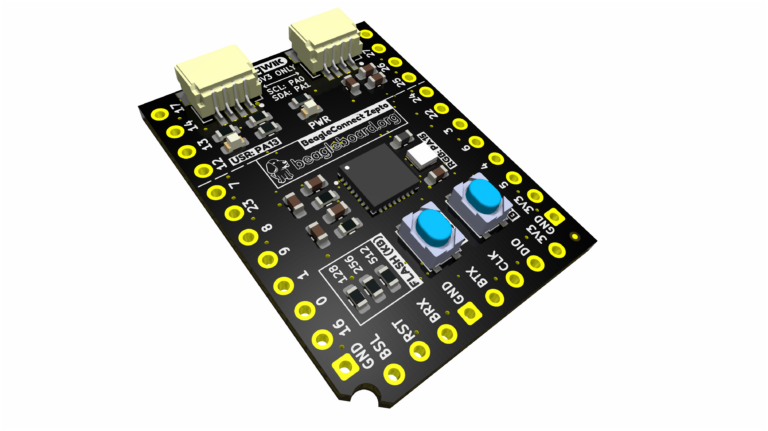
In a world where even the cheapest microcontrollers seem to cost more than a cup of coffee, BeagleBoard.org has done something remarkable: they’ve introduced a $1 computer. Called the BeagleConnect Zepto, this tiny board is designed to be so affordable that it could become the default “glue” for your embedded projects.
A $1 Computer: What’s the Catch?
At first glance, $1 seems too good to be true. But BeagleBoard.org isn’t a typical company — they’re a non-profit focused on open source hardware. Their goal isn’t maximizing margin; it’s creating something useful that will stay in production for over 10 years.
The secret to the low price:
- Texas Instruments MSPM0L1117 — an ultra-low-cost ARM Cortex-M0 MCU
- 2-layer PCB design — simple and cheap to manufacture
- Minimal connectors — only what’s essential
BeagleBoard.org worked with TI, PCB assemblers, and distributors to ensure everyone makes enough margin to keep producing it at this price point for a decade. That’s the “Beagle magic” — sustainable low pricing, not a fire-sale teaser.
Hardware Specifications
| Component | Specification |
|---|---|
| MCU | TI MSPM0L1117 |
| CPU | Arm Cortex-M0+ @ 32MHz |
| Flash | 128KB |
| RAM | 16KB |
| Form Factor | mikroBUS compatible |
| Connectors | 2x QWIIC, 1x HAT header |
| Price | $1 (yes, really) |
mikroBUS Compatible: 2,000+ Add-ons Ready
One of the Zepto’s smartest design choices is its mikroBUS compatibility. This standard (free to license) lets you plug in nearly 2,000 different Click boards from mikroElektronika — sensors, actuators, displays, wireless modules, and more.
Need a temperature sensor? There’s a Click board for that. GPS? OLED display? LoRa radio? All available off-the-shelf. No soldering required — just friction-fit and go.
QWIIC Connectors: Chain to Linux Hosts
The Zepto features two QWIIC connectors that let you chain it to other boards:
- BeaglePlay — BeagleBoard.org’s Linux SBC
- BeagleBadge — The hackable conference badge
- Any QWIIC-enabled device
Connect Zepto to a Linux host, and you get BeagleConnect Greybus for Zephyr — a protocol that exposes all the MCU’s peripherals to Linux over I2C. This means you can control sensors and actuators without writing any microcontroller firmware. Linux already has drivers for 200+ mikroBUS boards, with more being added constantly.
HAT Header: Raspberry Pi Compatible
One edge of the Zepto is designed for HAT connectors (the same standard Raspberry Pi uses). This provides:
- Power
- Reset
- Programming
- Communication
The HAT header lets you use the BeagleBoard Imaging Utility to flash a complete development environment — no complex setup required.
Software: Zephyr RTOS, Arduino, MicroPython
The primary software platform for Zepto is the open-source Zephyr RTOS. But you’re not locked in:
- Arduino Core — Write in familiar Arduino syntax
- MicroPython — Python on the metal
- VS Code Coder — Browser-based development environment
For users who want the full Linux experience, Zepto connects to BeaglePlay or BeagleY-AI, giving you a seamless path from prototype to full-featured IoT device.
Open Source, Community Driven
The Zepto design was contributed by Deepak Khatri, a long-time BeagleBoard community member and former Google Summer of Code intern. He’s the founder of Upside Down Labs.
All design files are available on:
- GitHub: github.com/beagleboard/beagleconnect-zepto
- OpenBeagle: openbeagle.org
Join the community:
- Forum: forum.beagleboard.org
- Discord: 3,000+ members
- Zulip: zulip.openbeagle.org
Use Cases
What can you do with a $1 computer?
Sensor Node
Attach a Click board sensor, connect to BeaglePlay via QWIIC, and you have an IoT sensor node for under $5 total.
Controller for BeagleBadge
Use Zepto as a game controller for the BeagleBadge — the author is building exactly this.
Prototyping Platform
Test ideas quickly with thousands of compatible add-ons before committing to a custom PCB.
Education
At $1 per student, Zepto makes embedded systems education accessible in ways that $20 boards never could.
Disposable IoT
For projects where cost matters more than recovery — smart packaging, one-way sensors, event tracking.
Conclusion
The BeagleConnect Zepto isn’t trying to be a Raspberry Pi competitor. It’s something more interesting: a ubiquitous embedded module that costs so little you can use it everywhere.
At $1, you could:
- Put one in every room of your house
- Include it in every prototype
- Deploy it in volume for commercial products
- Give them out at hackathons without blinking
The combination of mikroBUS compatibility, QWIIC chaining, and Zephyr software support makes Zepto a incredibly flexible building block. BeagleBoard.org has once again proven that open source hardware can drive prices down while keeping quality high.
Prototypes are available today. Head to the BeagleBoard.org blog to learn more.