
WCH (Nanjing Qinheng Microelectronics) has expanded its CH32V20x lineup with the CH32V205, a connectivity-focused RISC-V microcontroller that crams dual USB interfaces, 10M Ethernet MAC+PHY, and a CAN 2.0B controller into packages as small as QFN28. Based on the self-developed Qingke V4B RISC-V core running at up to 144 MHz, the CH32V205 targets industrial control, IoT gateways, and embedded networking applications where multiple communication interfaces are a hard requirement—not a luxury.
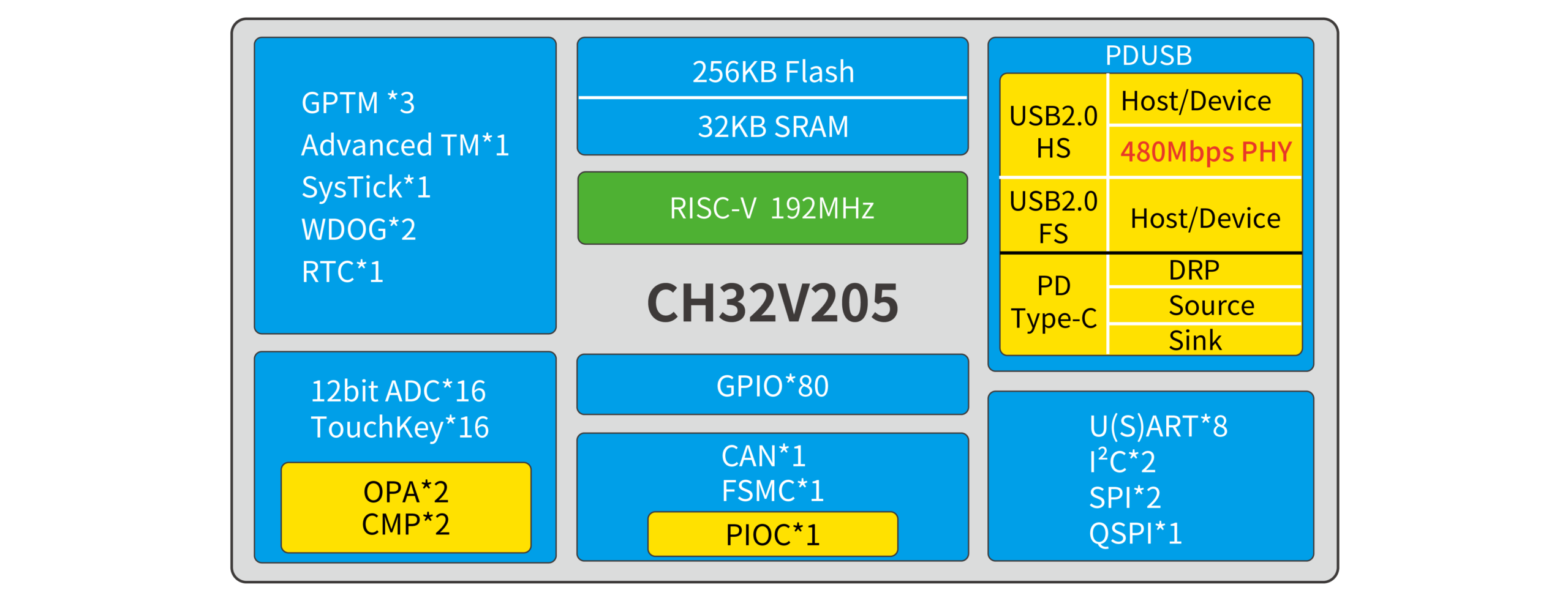
The CH32V20x Family: Where the CH32V205 Fits
The CH32V20x series spans several sub-families, each tuned for a different use case:
| Model | Core | Key Differentiator | Flash / SRAM |
|---|---|---|---|
| CH32V203 | V4B | Enhanced low-power, dual USB, CAN | 64KB / 20KB |
| CH32V205 | V4B | Connectivity: dual USB + Ethernet + CAN | 256KB / 64KB |
| CH32V208 | V4C | Wireless: BLE 5.3 + Ethernet + USB + CAN | 480KB / 64KB |
While the CH32V203 focuses on low-power general-purpose applications and the CH32V208 adds Bluetooth LE wireless, the CH32V205 sits in the middle as the wired connectivity champion—offering both Ethernet and dual USB without the wireless radio, at a lower cost point.
Core Architecture: Qingke V4B
The CH32V205 is built around WCH’s self-developed Qingke V4B 32-bit RISC-V processor core, which goes well beyond a vanilla RV32IMAC implementation:
- Hardware interrupt stack + fast interrupt entry — unlike standard RISC-V, the V4B saves interrupt context to dedicated hardware registers rather than software-managed stacks, dramatically reducing interrupt latency
- Branch prediction and hazard handling — the pipeline includes mechanisms to minimize stalls from conditional branches
- Single-cycle multiplication and hardware division — no multi-cycle penalties for arithmetic operations
- 144 MHz zero-wait-state execution from on-chip Flash
These enhancements are particularly relevant for real-time applications where deterministic interrupt response matters more than raw DMIPS benchmarks.
Memory and Storage
The CH32V205 provides significantly more memory than the CH32V203:
- 256KB Code Flash (zero-wait application area + non-zero-wait data area)
- 64KB SRAM for runtime data
- 28KB system BootLoader
- 128B system configuration area + 128B user-defined information area
The 4:1 Flash-to-SRAM ratio suggests the chip is optimized for code-heavy applications—protocol stacks for USB, Ethernet, and CAN consume considerable program space, and 256KB provides comfortable headroom.
Connectivity: The Real Story
What makes the CH32V205 interesting is not any single peripheral, but the combination of three wired interfaces that rarely coexist in this price range:
Dual USB 2.0
- 1× USB 2.0 Full-Speed Host/Device (OTG-capable)
- 1× USB 2.0 Full-Speed Device
- Both interfaces include integrated PHY—no external transceivers needed
The dual-USB architecture enables scenarios like acting as a USB device to a host PC while simultaneously reading from a USB flash drive in host mode—a common requirement for data loggers and industrial gateways.
10M Ethernet (MAC + PHY)
- Integrated 10 Mbps Ethernet MAC and PHY
- On-chip transformer driver—no external magnetics required for basic operation
While 10 Mbps may seem modest, it is perfectly adequate for Modbus/TCP, MQTT, SNMP, and other lightweight industrial protocols. The integrated PHY eliminates the cost and board space of an external Ethernet transceiver.
CAN 2.0B
- 1× CAN controller (CAN 2.0B Active)
- Supports standard and extended frames
CAN remains the backbone of industrial and automotive communication. Having it alongside USB and Ethernet on a single chip simplifies gateway designs that bridge between CAN bus networks and IP-based systems.
Analog and Mixed-Signal Peripherals
- 2× Operational Amplifier / Comparator — can be connected directly to ADC and timers for motor control and sensor signal conditioning
- 12-bit ADC — multi-channel analog-to-digital conversion with dual conversion modes
- TouchKey detection — capacitive touch sensing without external components
- DMA controller — 2 groups with 18 channels total, supporting circular buffer management for USART, ADC, I2C, SPI, and timers
The on-chip op-amps are a distinctive feature that can replace external comparator ICs in cost-sensitive designs, particularly for over-current detection in motor drives or battery monitoring in power tools.
Timer Ecosystem
- 1× 16-bit Advanced Timer with dead-band control and emergency brake (for motor PWM)
- 3× 16-bit General-Purpose Timers (input capture / output compare / PWM / encoder input)
- 1× 32-bit General-Purpose Timer
- 2× Watchdog Timers (independent and windowed)
- 1× 64-bit SysTick counter
Serial Interfaces
- 4× USART
- 2× I2C (with SMBus/PMBus support)
- 2× SPI (up to 72 MHz in master mode)
With four UARTs and dual SPI, the CH32V205 can simultaneously communicate with multiple sensors, displays, and wireless modules—a key advantage for multi-protocol gateway applications.
Power Management
- Operating voltage: 2.5V / 3.3V with independent GPIO supply
- Low-power modes: Sleep, Stop, Standby
- Running power: as low as 44.65 μA/MHz (V4B core optimization)
- VBAT pin for RTC and backup register retention
Package Options
The CH32V205 is available in multiple package configurations:
- LQFP64M — full pinout, maximum I/O
- QFN48 — compact footprint
- QFN28 — ultra-compact for space-constrained designs
- LQFP48 — balanced option
- TSSOP20 — minimal pin count for simple applications
The QFN28 option is particularly notable—getting Ethernet, dual USB, and CAN into a 28-pin package is unusual and opens the door to very small form-factor gateway designs.
Development Ecosystem
WCH provides a comprehensive development toolchain:
- MounRiver Studio — Eclipse-based IDE with RISC-V toolchain integration
- WCH-Link — dedicated debug probe supporting serial wire debug
- Arduino-compatible core — community-maintained Arduino port for CH32V series
- Extensive SDK and example code covering USB, Ethernet, CAN, and peripheral drivers
Who Should Consider the CH32V205?
The CH32V205 fills a specific niche: applications that need multiple wired communication interfaces simultaneously. Some obvious candidates:
- Industrial protocol gateways — bridging CAN bus to Ethernet/IP networks with USB for configuration
- Data loggers — reading sensors over CAN or serial, storing data to USB flash drive, reporting via Ethernet
- Smart energy meters — Meter-Bus (M-Bus) over UART, CAN for daisy-chaining, Ethernet for backhaul
- Motor controller with connectivity — on-chip op-amps for current sensing, CAN for multi-axis coordination, Ethernet for remote monitoring
Pricing and Availability
The CH32V205 is available now through WCH’s distribution channels. Pricing starts at under $1 in volume, making it one of the most affordable options for triple-interface (USB + Ethernet + CAN) connectivity in the RISC-V MCU space.
Resources
- Product Page: wch-ic.com/products/CH32V205
- Datasheet: Available on the WCH product page
- GitHub: Community projects and Arduino core at github.com/openwch
- MounRiver Studio: mounriver.com