
WireClaw is a next-generation embedded AI agent framework — running a real AI agent on a $5 ESP32 chip, turning intent directly into hardware signals. It is OpenClaw’s physical world extension: OpenClaw controls files, WireClaw controls wires; OpenClaw lives in your laptop, WireClaw lives in the wall.
Core Philosophy: AI That Lives on the Wire
WireClaw’s slogan is straightforward: OpenClaw controls files. WireClaw controls wires. It’s not another “control your lightbulb with your phone” IoT toy — it’s a genuinely reasoning AI Agent running directly on a microcontroller, requiring no cloud, no subscription, no internet.
Hardware Support: Three ESP32 Chips
- ESP32-C6 — Wi-Fi 6 and Bluetooth 5.3, the latest generation
- ESP32-S3 — Powerful dual-core Xtensa LX7, Wi-Fi + BLE 5.0, great for AI inference
- ESP32-C3 — RISC-V single core, king of cost performance, ultra-low power
All chips cost around $5 — the price of a coffee — to get a complete, capable AI agent.
Key Features at a Glance
$5 AI Agent — True On-Device Reasoning
WireClaw is not a remote control. It’s an AI Agent with tool-calling capabilities. It can call 20 tools (read sensors, write GPIO, send Telegram messages, etc.), with up to 5 reasoning iterations per request. It supports OpenRouter (GPT-4o, Claude, etc.) or fully local Ollama/llama.cpp — no API key, no internet, no cloud required.
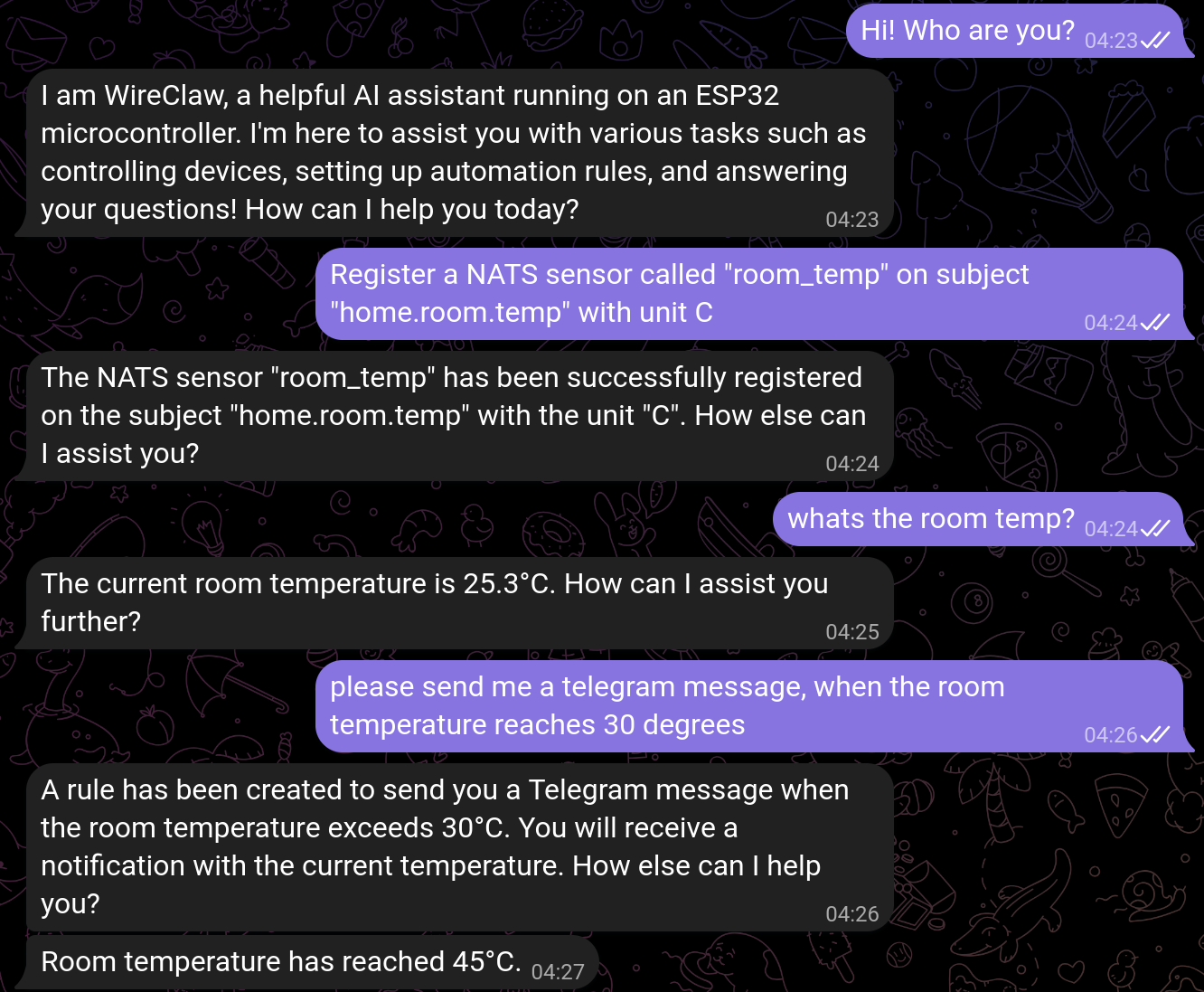
You can chat with it via Telegram: register a sensor, ask for temperature, set an alert, receive a notification.
Persistent Memory
Tell it “my favorite color is blue,” reboot, then ask it to set the LED to your favorite color — it remembers. 512 bytes of Flash storage, written and persisted, auto-loaded on boot. Every device becomes an “individual with memory.”
Rule Engine — AI Creates, Rules Run Independently
This is WireClaw’s most unique design: AI is responsible for creating rules, rules run independently without AI. A typical use case:
Sensor reading > 32 C — alert — 5 seconds later — LED turns red — 10 seconds later — LED turns off
This rule is permanently saved on the chip, survives reboots. No LLM, no cloud, pure local edge triggering.
Multi-Channel Control
The same intelligence, accessible through different interfaces:
- Telegram Bot — Natural language conversational control
- USB Serial — Serial command line interaction
- NATS — Lightweight message bus, supports device mesh interconnection
Serial Bridge
WireClaw’s serial capability lets it connect to any serial device: Arduino, GPS modules, CO2 sensors, and more. This data can serve as WireClaw sensor inputs, triggering rules or being read by the Agent — giving legacy hardware AI capabilities.
Device Mesh
Multiple WireClaws communicate with each other via NATS. You can query another WireClaw on the network, trigger cross-device rules, building a network of $5 autonomous agents.
OpenClaw Integration: Desktop AI Gets a “Body”
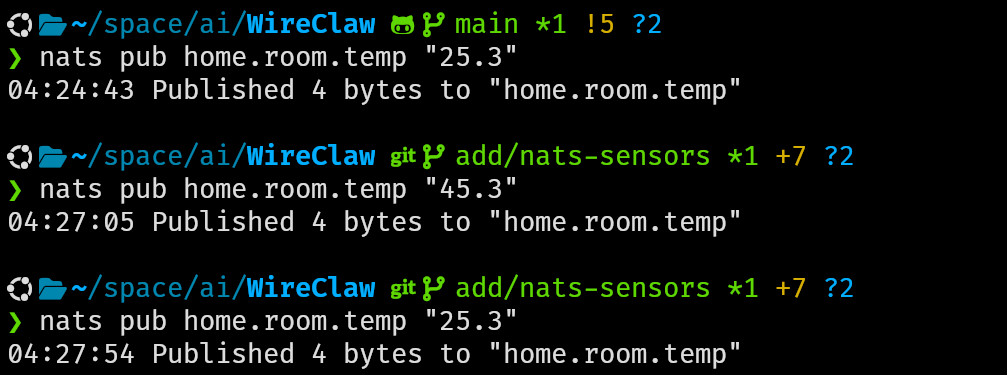
This is one of WireClaw’s most exciting features: OpenClaw + WireClaw = AI Agent with a Body.
Integration takes just three steps:
- Install the Skill: Tell OpenClaw to install the WireClaw skill from GitHub. The entire integration is a single markdown file (SKILL.md). OpenClaw reads it and learns all tool call syntax — no SDK, no plugins
- Start a NATS Server: OpenClaw and WireClaw communicate through the NATS message bus. Point both at the same NATS server and they auto-discover each other
- Start Talking: Tell OpenClaw to discover devices on your network using WireClaw, then simply say “set the LED to purple” — 30ms response time
The entire OpenClaw Skill consists of just two files: SKILL.md (tool description) + wc.sh (NATS CLI wrapper), all plain text, no compilation required.
Use Cases
- CI Build Light: OpenClaw monitors GitHub Actions, WireClaw’s LED receives NATS messages — green for pass, red for fail
- Morning Wake-Up Light: Orange LED at 7:30 AM, off at 8:00 AM. Pure local time-based rules, no cron, no cloud
- Weather-Responsive Desk Lamp: OpenClaw queries weather forecast, publishes temperature to NATS; WireClaw sets LED color — blue when cold, red when hot, green when comfortable
- Server Rack Temperature Alert: NTC thermistor connected to ESP32. Sends Telegram alert when exceeding 40 C. No polling, no lambda
- Live Event Monitor: Subscribe to wireclaw-01.events, view rule triggers, sensor readings, and status changes in real time
Web Configuration Portal
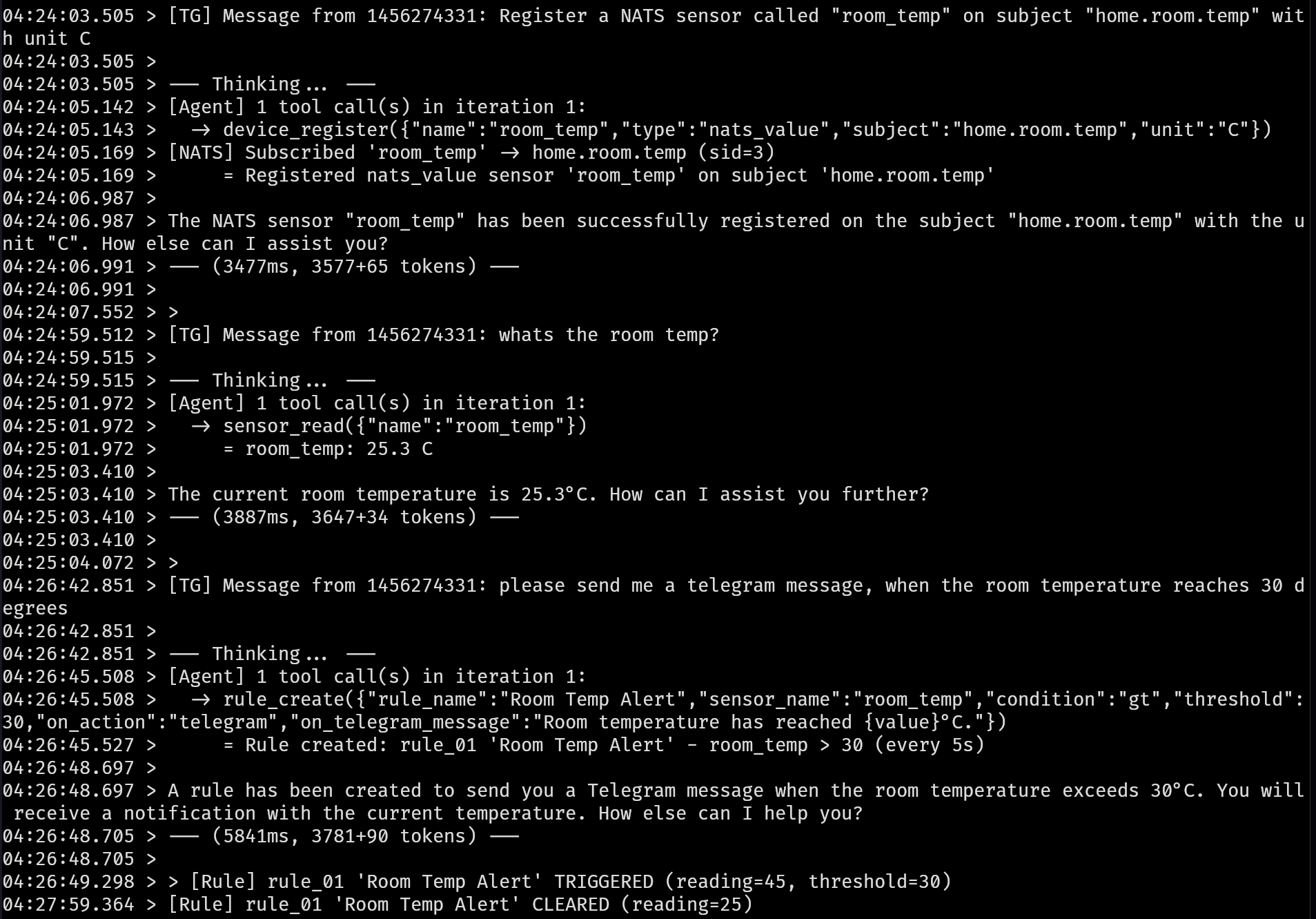
No reflashing needed. Open your browser to device.local to access the configuration portal. Edit system prompts, memory content, and parameters anytime — changes take effect immediately.
Supported Sensors and Actuators
Inputs (Sensors / Conditional Triggers):
- Temperature (DS18B20, NTC)
- Light intensity
- GPIO level status
- NATS message values (cross-device data)
- Real-time clock (time-based triggers)
- Serial data
Outputs (Actuators / Actions):
- LED (GPIO output)
- GPIO pins
- Relay
- PWM dimming
- Telegram message push
- NATS publish
- Serial command sending
Technical Architecture
| Component | Technology |
|---|---|
| AI Model | OpenRouter API or Ollama local models |
| Message Bus | NATS (lightweight, high-performance, auto-discovery) |
| Communication | Wi-Fi + NATS / USB Serial / Telegram Bot |
| Persistence | ESP32 Flash (512 bytes user storage) |
| Rule Engine | Local edge triggering, LLM-free, supports delays and chains |
| Tool Count | 20 tools (continuously expanding) |
| Firmware Update | Web configuration portal, no reflashing |
WireClaw vs OpenClaw
| Dimension | OpenClaw | WireClaw |
|---|---|---|
| Runtime | Desktop/server (Mac/Linux/PC) | ESP32 microcontroller ($5 chip) |
| Perception | Files, code, network, APIs | GPIO, sensors, hardware signals |
| Control | Software systems, file systems | LEDs, relays, motors, serial devices |
| Deployment | Install/configure | Flash firmware |
| Network Dependency | Required (LLM API calls) | Optional (local models can run offline) |
| Latency | Network latency (LLM API) | Local 30ms (NATS) |
Getting Started
- Website: wireclaw.io
- OpenClaw Integration: wireclaw.io/openclaw-integration
- GitHub Skill: github.com/M64GitHub/WireClaw
- Online Demo: wireclaw.io/config-portal
Conclusion
WireClaw represents a new AI deployment paradigm: not cloud AI controlling devices, but AI itself running on the device. Its value proposition is clear — get a complete on-device reasoning Agent on a $5 chip, seamlessly integrated with OpenClaw via NATS, giving desktop AI the ability to sense and control the physical world. The rule engine ensures all automation runs locally and permanently, intelligence continues even without internet.
For hardware enthusiasts, it’s the most cost-effective AI embedding solution available. For OpenClaw users, it’s the final piece of the puzzle that gives AI “hands and feet.”